




Near Me SEO Without Spam: How Local Businesses Can Capture High-Intent Searches Across Multiple Locations
“Near me” SEO is where local demand gets holy fast. People searching for a service with local intent are usually trying to solve a problem now, compare providers quickly, or find the nearest credible option without doing a week of research.
This guide is for multi-location businesses, service-area brands, and the marketers behind them, especially in home services, legal, healthcare, BPO, and other trust-heavy categories. If you need better local lead generation SEO, stronger city page SEO, and localized landing pages that do not look like spun nonsense, this will show you what to build, what to avoid, and how to expand without summoning a spam penalty.
And yes, we are called Content God. We apologize for any confusion that has caused in theological or branding circles. Now that the apology is complete, let us speak with appropriate authority: most “near me SEO” failures happen because businesses try to fake local relevance instead of proving it.

What near me SEO actually means
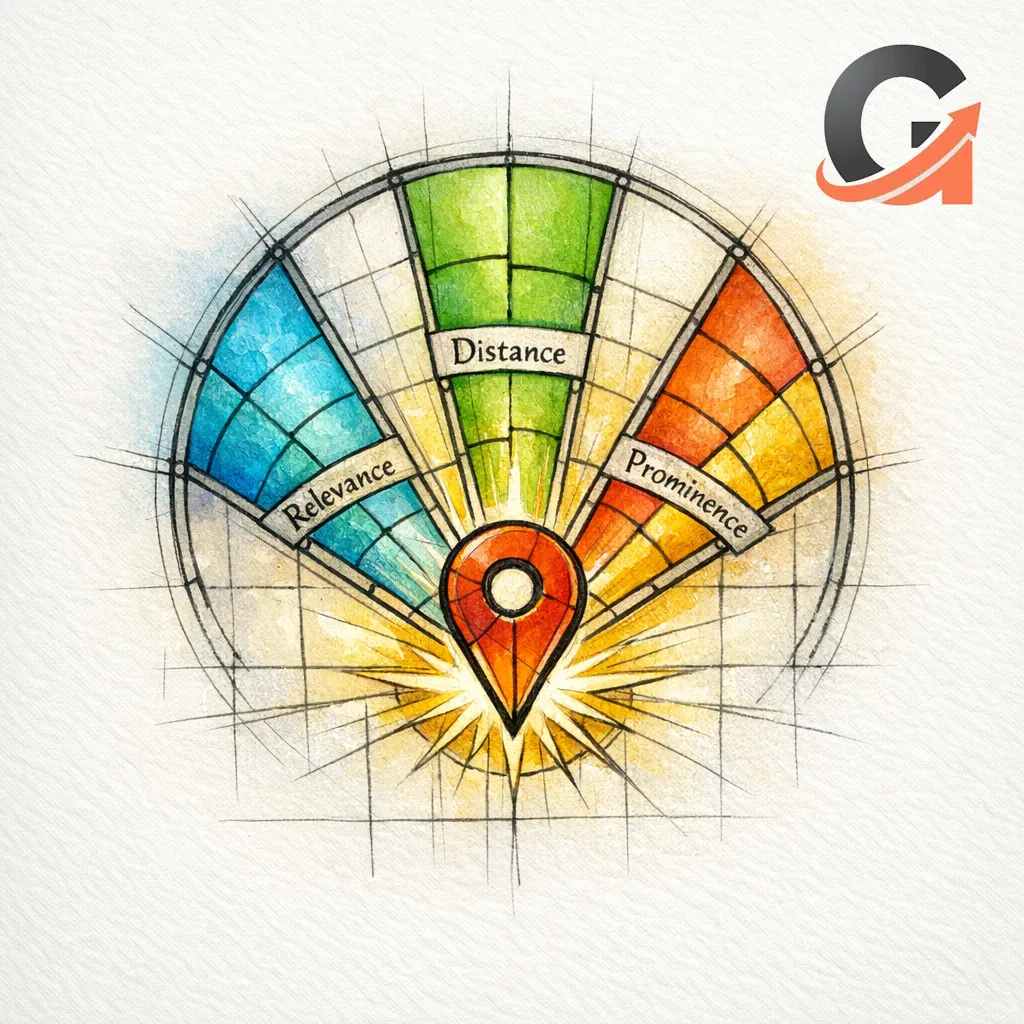
Near me SEO is not mainly about stuffing the exact words “near me” into every headline. In local search, Google says rankings are influenced by relevance, distance, and prominence, which means your pages and profiles need to clearly match the service, the geography, and the trust signals a searcher expects.
That matters whether the search is “AC repair near me,” “seo agency near me,” “garage door company near me,” or “personal injury lawyer near me.” The phrase may change, but the underlying job is the same: show the search engine and the human that you truly serve that market and deserve the click.
For local SEO multi-location campaigns, that usually means mapping search intent into a clean page system. One page cannot do the job of every service, every city, and every audience at once, especially when you want to scale local business SEO expansion without turning your site into a cemetery of duplicate pages.
Why spammy local expansion fails

The old playbook was simple and terrible: clone one page 80 times, swap the city name, add a few sentence fragments about “trusted experts,” and hope Google sorts it out later. The problem is that Google’s spam policies explicitly address doorway abuse, which includes pages made to rank for specific queries when they funnel users into essentially the same destination without adding distinct value.
That same risk gets worse when businesses use AI or templates carelessly. Google also warns against scaled content abuse when pages are produced primarily to manipulate rankings rather than help people, so volume alone is not a moat if the pages are empty, repetitive, or deceptive.
This is why so many location landing pages underperform even when they are technically indexed. They may exist on the site, but they do not give a searcher a strong reason to believe, “Yes, this business serves my area, understands my problem, and can help me now.”
The right model for local SEO across multiple locations
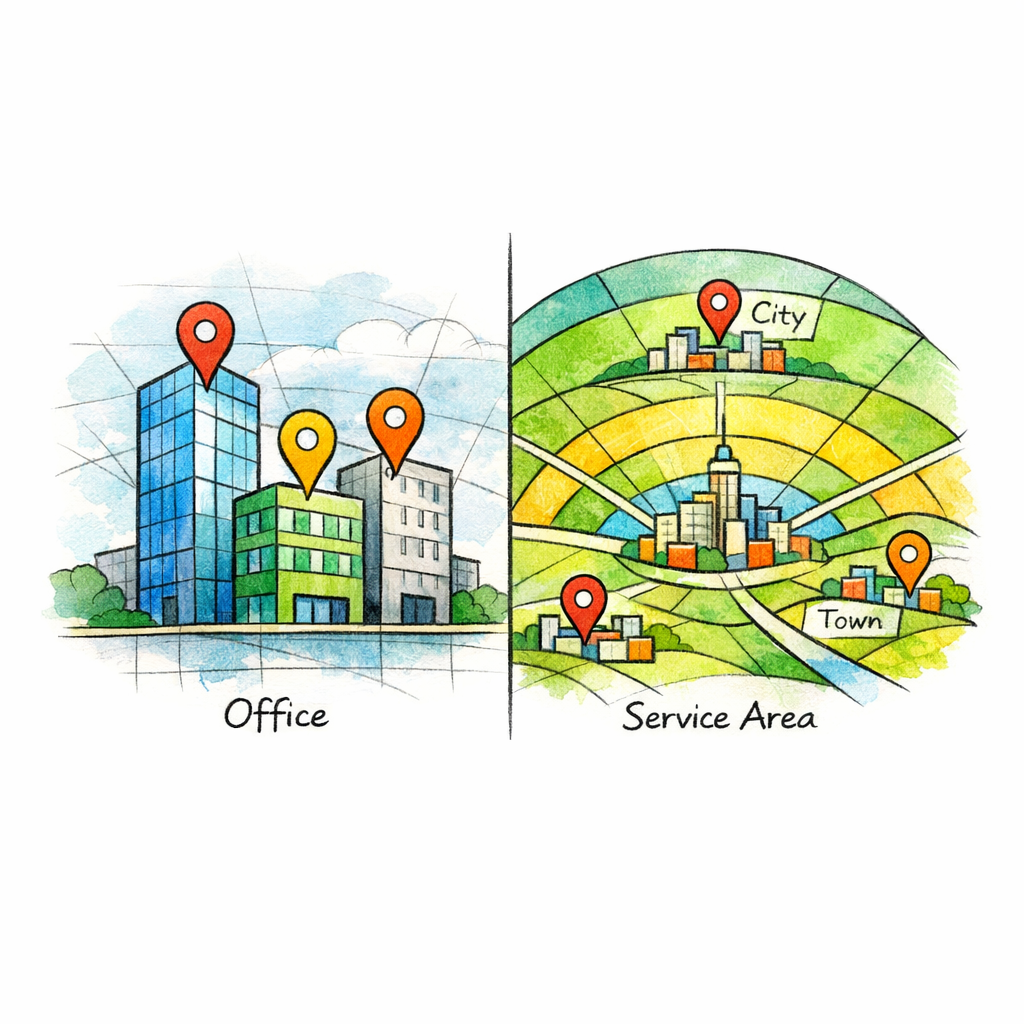
Physical locations
If you have real, customer-facing offices, each legitimate location can support its own location page, its own local proof, and its own business profile strategy. The strongest location pages are not carbon copies; they explain what is offered there, who the team serves there, and why that office matters to people in that market.
For a roofing company, that may mean different storm patterns, insurance workflows, and neighborhood housing stock. For a law firm, it may mean the courts, case mix, language support, or intake differences by market. For healthcare-adjacent brands, it may mean distinct specialties, provider availability, or regional patient needs.
Service-area businesses

If you do not operate a staffed office in every city you target, you can still build service area SEO the right way. Google’s Business Profile guidelines for service-area businesses make clear that businesses should represent themselves accurately, and businesses that visit customers can define service areas without pretending every target city is a storefront.
That is the line many brands cross. A plumber who truly serves five cities can create strong city or area pages that explain coverage, response times, service differences, and local proof. A plumber who invents fake offices, fake staff, or fake addresses is not doing local search engine optimization. They are manufacturing fiction.
How to build local landing pages SEO without creating doorway pages

The goal is not to make more pages. The goal is to make fewer, stronger pages that align with real demand clusters and give each market a reason to rank and convert.
Start with a clean page architecture
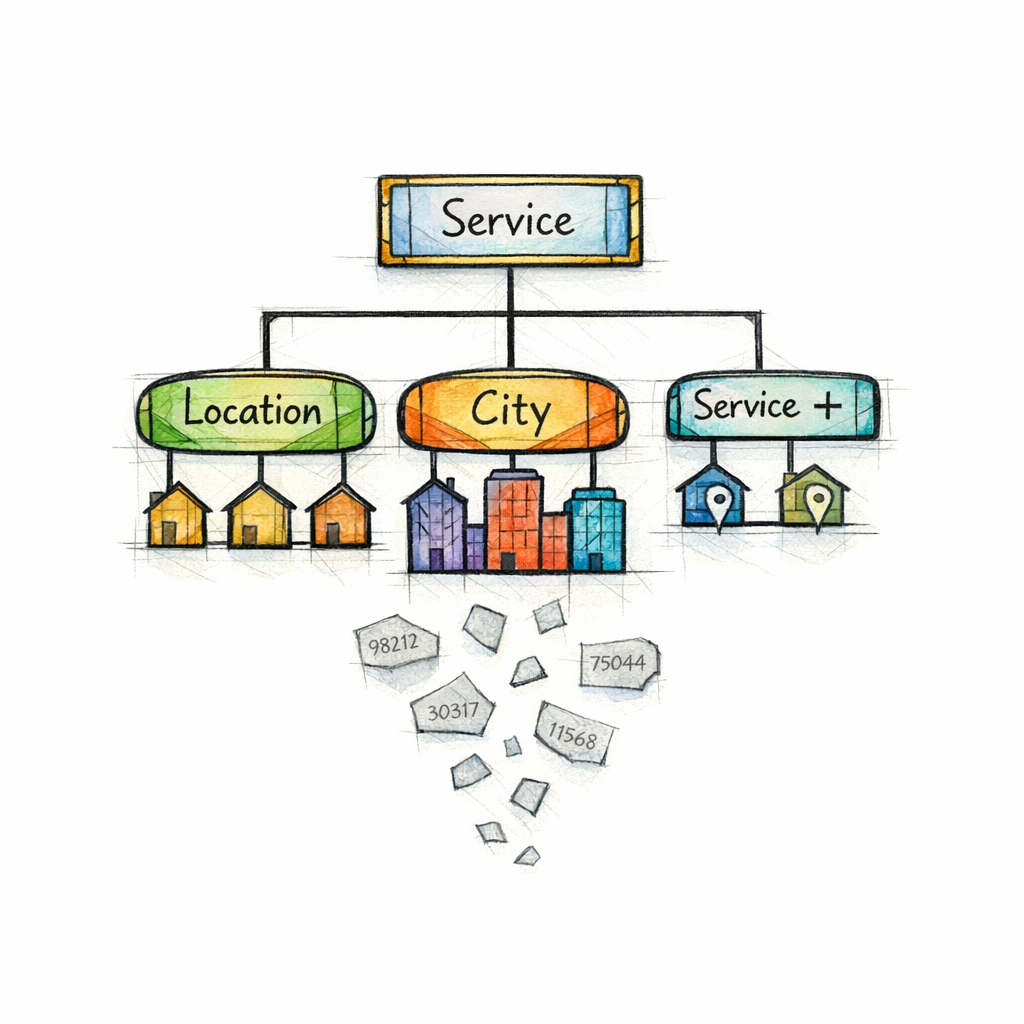
For most businesses, the safest structure looks like this: a core service page, real location pages for real offices, and carefully chosen city or regional pages for meaningful service areas. If every town gets the same copy and the same offer, you probably do not need more pages. You need better targeting.
- Use location pages for real offices or customer-facing branches.
- Use city pages for major service markets where search demand and operational coverage are real.
- Use service-plus-location pages only when the service has unique intent in that market, such as “emergency electrician in Scottsdale” or “personal injury lawyer in Tampa.”
- Avoid one page per ZIP code, subdivision, or nearby town unless the page can genuinely stand on its own.
Give every local page unique commercial value

A location modifier is not unique value. “Plumbing in Phoenix” and “plumbing in Mesa” are different only if the page reflects a real difference in service delivery, response model, trust elements, or customer concerns.
Each page should answer questions a local buyer actually has. What services are available in that area? How fast can you respond? What kinds of homes, legal matters, patient needs, or support requests are most common there? What proof can you show from that geography?
- Write a market-specific opening instead of recycling the same first paragraph.
- List services actually offered in that area rather than your full master menu by default.
- Add local proof such as testimonials, case examples, project photos, certifications, or team context that matter to that market.
- Clarify coverage with neighborhoods, nearby communities, or service radius language that matches reality.
- Answer local objections like permits, urgency, insurance, appointment availability, or intake process.
Support the page with sitewide signals

One location page cannot carry local SEO by itself. It needs reinforcement from internal links, consistent business information, review generation, and a sensible content strategy around the services people search before they are ready to call.
This is where many local businesses miss the larger system. A city page for “water heater repair” gets stronger when your site also has useful content on replacement vs repair, common failure signs, emergency response expectations, and financing or warranty questions. The local page captures demand. The broader content ecosystem creates topical confidence.
When appropriate, add LocalBusiness structured data to help search engines understand important local business details. Structured data does not save a weak page, but it can support a page that already has real substance and clear local intent.

What changed in local SEO

The big shift is not that Google suddenly hates local pages. It is that the standards for scaled local content are clearer and less forgiving. Between the published rules around doorway pages and scaled abuse, and Google’s continued emphasis on helpful, reliable, people-first content, the winning approach is no longer “publish more local pages than everyone else.” It is “publish pages that deserve to exist.”
That changes how local SEO content strategy should be planned. Instead of asking, “How many cities can we hit this quarter?” the better question is, “Which markets can we support with real operational truth, differentiated copy, and conversion-ready proof?”
This is especially important for sensitive categories. In legal, healthcare, and other trust-heavy industries, generic location copy feels weak because the searcher is already cautious. Thin pages do not just underperform in rankings. They also underperform with humans.

How to choose the right local keywords without turning your copy into sludge

High intent local keywords usually combine a service, a location, and a buyer state. That buyer state might be urgency, price comparison, specialty, insurance, timing, or proximity. The magic is not in repeating the phrase endlessly. The magic is in matching the page to the problem behind the phrase.
For example, a home services company may need a different page strategy for “emergency plumber near me” than for “water heater installation in Plano.” A law firm may need separate intent handling for “car accident lawyer near me” versus a broader city page. A local SEO agency may want one strong page for “local seo service near me” and a different educational page for businesses evaluating providers.
That means your keyword map should separate:
- Location intent such as city, county, neighborhood, or region.
- Service intent such as repair, installation, consultation, treatment, defense, or support.
- Urgency intent such as emergency, same-day, 24/7, fast response, or free consultation.
- Audience intent such as residential, commercial, enterprise, families, startups, or Spanish-speaking clients.
If you combine all of that on one page, you usually create mush. If you separate it intelligently, you create location pages for SEO that can rank, convert, and scale.

Common mistakes and misconceptions
“We need a page for every city near us”
No, you need pages for markets that matter operationally and commercially. If two nearby cities behave like one market, one strong page may outperform two thin ones.
“We need to say ‘near me’ everywhere”
Not necessarily. If your page clearly communicates the service, geography, and trust signals that local buyers need, the page can still align with near me SEO without sounding like a robot wrote it during a caffeine crisis.
“We can use virtual offices or fake addresses to look bigger”
That is where local growth turns into self-sabotage. Google expects businesses to represent themselves accurately on Google, so fake-location tactics may create short-term visibility and long-term pain.
“City pages are enough”
They are not. If your Google Business Profile is weak, your internal linking is thin, your reviews are stale, and your content strategy ends at a pile of localized landing pages, you are asking one page type to do the work of an entire local SEO system.
“AI can scale this instantly”
AI can accelerate drafting and production. It cannot manufacture real local proof, real operational differences, or a believable offer in every market. If the inputs are generic, the outputs will preach a false gospel.
What to do next

If your business wants better local lead generation SEO across multiple markets, use this checklist before you publish another page.
- Audit every existing location page and remove or merge pages that add no unique value.
- Separate real office pages from service-area pages so your site reflects how the business actually operates.
- Choose expansion markets based on revenue potential and real coverage, not just on a giant list of nearby cities.
- Create a keyword map by service, market, and buyer intent before writing anything.
- Build unique local proof into every page, including testimonials, projects, case details, or market-specific FAQs.
- Improve internal links from service pages, blog content, and navigation into your highest-value local pages.
- Align your Business Profile strategy with your website strategy so your local signals do not contradict each other.
- Measure leads by page cluster so you know which markets deserve deeper investment.

If you do this well, near me SEO stops being a game of city-name stuffing and becomes a system for capturing high-intent local demand. That is true for an HVAC company expanding into three counties, a criminal defense firm building regional visibility, a healthcare brand launching city-specific resources, or a marketing team trying to rank for “search engine optimization near me” without looking desperate.
At Content God, we see this constantly: businesses do not usually lose because they lack opportunity. They lose because their local landing pages SEO strategy was built like a spreadsheet exercise instead of a trust-building asset. Repent of the duplicate page factory, and your rankings may yet be saved.
Get a free SEO audit today!

If your site has thin city pages, confused service area SEO, or a local seo content strategy that feels more chaotic than divine, we can help you find the leaks fast. A practical audit will show where your current structure is blocking rankings, where your best local business SEO expansion opportunities live, and which pages should be rebuilt, merged, or scaled.
If you want help turning scattered location pages into a serious growth engine, get a free SEO audit today! And if you are done praying for better search results, stop praying for better search results — download your free copy of the SEO Bible and learn the true path to SEO Salvation. If your team would rather outsource the blog and content pipeline than keep rewriting the same city page sermons, Content God is ready to deliver the scripture.